
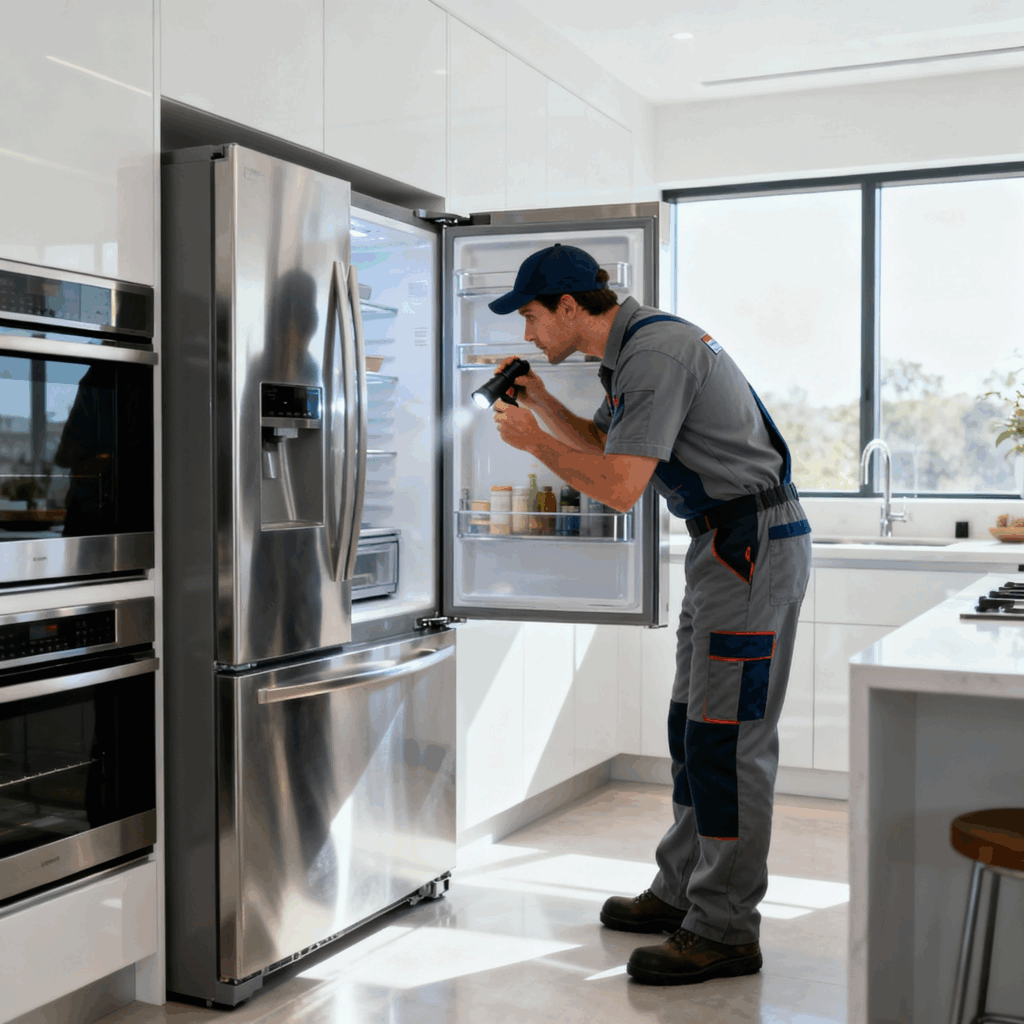
MYTH #1: “It Still Works, So It’s Fine”
What people think: If the fridge keeps food cold and the dishwasher eventually gets dishes clean, there’s no reason to think about maintenance or consider timely residential appliance repair for optimal kitchen performance until something catastrophically fails.
What actually happens: Appliances don’t binary-switch from “perfectly fine” to “completely dead.” They decline gradually, burning extra electricity, straining components, and broadcasting distress signals that homeowners trained to ignore malfunctions until catastrophe strikes completely miss. When homeowners finally acknowledge the need for expert appliance repair for extended equipment lifespan, they discover that the $150 fix six months ago has become a $600 replacement today.
The parallel to home architecture proves instructive. Nobody waits until roofs collapse before addressing leaks. Small interventions prevent expensive disasters. Understanding how family-focused appliance maintenance preserves both equipment and quality of life reveals why proactive care beats reactive panic. Similarly, Consumer Reports’ repair-or-replace guidance demonstrates how informed decisions about appliance care protect both budgets and home functionality.
That refrigerator running constantly? It’s not trying harder, it’s struggling. The dishwasher taking three hours? Something’s wrong. The oven temperature swinging wildly? Address it before the Thanksgiving turkey becomes a family legend for the wrong reasons.
MYTH #2: “Appliance Repair People Just Want to Sell You Stuff”
What people think: Technicians diagnosing problems invariably recommend unnecessary repairs, parts, or replacements driven by commission rather than actual equipment needs. Better to soldier on with malfunctioning equipment than risk getting fleeced.
What actually happens: Reputable repair services build businesses on repeat customers and referrals, not one-time gouging. They understand that recommending a $50 gasket replacement preserves customer relationships far better than inventing a $400 control board failure. The industry has bad actors, certainly, but assuming all technicians are dishonest creates a self-fulfilling prophecy where people avoid maintenance until minor issues become legitimate catastrophes requiring exactly the expensive interventions they feared.
The architectural parallel holds here too. Would anyone assume every structural engineer inspecting foundations just wants to sell unnecessary shoring? Some homeowners trust construction experts while distrusting appliance technicians, despite both possessing specialized knowledge about complex systems.
Smart homeowners develop relationships with reliable service providers before emergencies strike. Having a trusted technician familiar with your equipment means faster diagnosis, honest assessments, and priority scheduling when problems emerge. This beats frantically googling repair services at 9 PM when the refrigerator starts making concerning noises and tomorrow’s dinner party food sits in jeopardy
.

MYTH #3: “Extended Warranties Are Always Scams”
What people think: Extended warranties represent pure profit for retailers, covering equipment during years it’s least likely to fail while charging premiums exceeding probable repair costs.
What actually happens: The calculation depends entirely on specific circumstances. For basic appliances with limited features, extended warranties often prove poor value. For complex integrated systems with expensive electronic controls, the math shifts considerably. A $300 extended warranty covering a $3,000 refrigerator with a history of control board failures at year four suddenly looks less like a scam and more like sensible insurance.
The key lies in researching specific model reliability rather than making blanket judgments. Consumer Reports publishes extensive appliance reliability data showing which brands and models commonly fail and when. A model with excellent five-year reliability needs no extended coverage. One with documented fourth-year electronic failures might justify the investment.
Consider also household circumstances. Families with young children where appliances work harder might value coverage more than empty-nesters with light usage. Homeowners planning to remain in place long-term have different risk calculus than those expecting to move within a few years. There’s no universal answer, only informed decisions based on specific situations.
MYTH #4: “If It’s Old, Just Replace It Rather Than Repair”
What people think: Modern appliances feature planned obsolescence, making repairs on aging equipment wasteful. Better to replace with newer, more efficient models than sink money into dying dinosaurs.
What actually happens: The age-replacement equation has flipped dramatically. Older appliances often feature simpler mechanical systems and more robust construction than contemporary models where electronic controls and plastic components dominate. A 15-year-old mechanical dishwasher might outperform and outlast a 3-year-old electronic model.
The energy efficiency argument deserves examination too. Yes, modern appliances use less electricity and water, but manufacturing new ones consumes substantial resources and energy. Repairing and maintaining existing equipment often proves more environmentally responsible than replacement, particularly for appliances still functioning well mechanically.
The calculus shifts when major components fail. Replacing compressors, motors, or control systems in aging appliances might cost more than new models, particularly when factoring in improved efficiency. But replacing door gaskets, unclogging drains, or fixing minor mechanical issues? Those repairs extend equipment life economically while delaying the environmental impact of manufacturing replacements.
Run the math rather than following rules of thumb. Calculate repair costs versus replacement costs and expected remaining lifespan. Factor in whether you actually need features new models offer. A perfectly functional basic refrigerator doesn’t become inadequate because new models offer smartphone integration.
MYTH #5: “Kitchen Appliance Placement Doesn’t Matter”
What people think: As long as appliances fit designated spaces and connect to necessary utilities, positioning represents pure aesthetic choice without performance implications.
What actually happens: Appliance placement profoundly affects both performance and lifespan. Refrigerators installed in direct sunlight work harder and fail faster. Dishwashers mounted without proper leveling drain poorly and develop mold problems. Ranges positioned too close to walls create dangerous grease buildup and ventilation issues.
The architectural integration piece proves critical here. Designers creating custom kitchens should consult appliance specifications early, not force equipment into spaces that compromise function. Counter depth matters. Ventilation clearances aren’t suggestions. Water supply accessibility affects both installation costs and future repair expenses.
Cabinet relationships influence appliance longevity too. Inadequate ventilation around refrigerators shortens compressor life. Dishwashers without proper sound insulation create noise issues that could have been prevented during installation. Ranges requiring specialized venting work best when ductwork gets planned during construction rather than awkwardly added afterward.
Smart kitchen design considers appliances as integral architectural elements rather than afterthoughts plugged in wherever they fit. This thinking prevents performance problems while facilitating future maintenance through thoughtful access planning.
The Truth Behind the Myths
These myths persist because they contain kernels of truth twisted into misleading conclusions. Yes, some appliances do work until they catastrophically fail. Some technicians do oversell. Extended warranties do represent profit centers. Old appliances do eventually need replacement. Placement sometimes proves merely aesthetic.
But reality proves more nuanced than myths suggest. Appliances communicate distress through subtle performance changes that attentive homeowners notice and address before catastrophic failures. Most technicians provide honest assessments because their businesses depend on satisfied customers. Extended warranties sometimes make financial sense. Older appliances often justify repair over replacement. Placement decisions affect both performance and longevity.
The through-line connecting all these myths involves treating appliances as disposable commodities rather than maintained investments. Homes represent the largest financial commitment most people make. The appliances making those homes functional deserve thoughtful care rather than neglect punctuated by panic when failures occur.
From an architectural perspective, kitchen appliances merit the same consideration as HVAC systems, plumbing, or electrical infrastructure. They’re not decorative elements or optional accessories. They’re essential systems supporting daily life, and like all such systems, they respond positively to regular maintenance and strategic intervention.
The modern kitchen has evolved far beyond its traditional utility room origins into the heart of contemporary homes. It’s where families gather, where entertaining happens, where significant portions of life unfold. The appliances enabling this central role deserve respect matching their importance. That means moving beyond myths into informed engagement with equipment care, maintenance, and strategic repair decisions.
Homeowners who recognize appliances as long-term investments rather than short-term conveniences find they save money, reduce stress, and maintain the kitchen functionality central to contemporary domestic life. The alternative involves believing myths that lead to neglect, emergency repairs, and premature replacements that strain budgets while disrupting routines.
The choice comes down to whether myths or reality guide appliance decisions. One path leads to frustration and expense. The other creates kitchens that work beautifully year after year through thoughtful care and timely intervention. For homeowners serious about creating and maintaining spaces they love, reality wins every time.
More Stories
How does Attic Air Leakage Affect Heating and Cooling Load Balance?
The Finest Designer Radiator Brands for High-End Residential Architecture Projects
The Anatomy of a High-End Bathroom Renovation: A 2026 Inside Look