
Large public environments — airport terminals, waterfront promenades, transport hubs or mixed-use districts — often struggle with the same spatial challenge: scale. When architecture operates at hundreds of meters in length and tens of meters in height, orientation becomes fragile and spatial hierarchy can dissolve into a continuous field of circulation.
Within these vast spatial systems, landmark artistic elements increasingly play a strategic role in organizing perception and movement. Studios working at the intersection of architecture, engineering and art — such as Dion Art Studio — approach sculptural installations not as decorative additions but as spatial instruments embedded within the architectural environment.
In these environments, sculptural installations increasingly operate not as decorative objects but as architectural devices. Their role extends beyond aesthetics into spatial structuring, visual anchoring and movement choreography. Particularly in the case of kinetic sculptures, movement introduces an additional dimension to architectural perception, turning static space into a dynamic spatial narrative.
For architects and urban designers, these installations can function as landmarks within the spatial logic of a project. They influence how people move, how volumes are perceived and how environments become memorable. In large developments — from airport terminals to cultural districts — kinetic installations are increasingly integrated as spatial instruments within the architectural composition itself.
Sculptural Landmarks and Spatial Hierarchy
In large architectural environments, spatial hierarchy is rarely defined by walls alone. Instead, it emerges through visual anchors — elements that organize perception and guide attention within expansive interiors or open plazas.
Museum atriums provide a clear example. Many contemporary museums employ large sculptural installations suspended within central voids. These objects become vertical markers that structure the space across multiple levels. Visitors entering the atrium instinctively orient themselves around the installation, using it as a spatial reference point when navigating galleries above or circulation routes below.
A similar principle operates in large commercial complexes. In mixed-use developments where retail, hospitality and entertainment overlap, the spatial experience can easily become disorienting. A landmark sculpture placed at a key intersection — where multiple circulation paths converge — introduces a visual hierarchy that clarifies the spatial structure.
Kinetic sculptures intensify this effect. Movement attracts peripheral vision, pulling attention across a large volume. The sculpture becomes not only a visual center but a constantly evolving spatial signal. Its motion draws people deeper into the environment, reinforcing the hierarchy established within the architectural composition.
Orientation and Navigation in Complex Public Spaces
Airports are perhaps the most complex public environments in contemporary architecture. Terminal buildings often extend over several hundred meters, with layered circulation routes connecting check-in areas, security zones, retail corridors and departure gates.
Traditional signage solves only part of the navigation problem. Human orientation in large spaces relies heavily on visual landmarks — distinctive spatial elements that anchor memory and guide movement.
A kinetic installation suspended within a terminal hall can operate as a navigational reference point. Imagine a long concourse where passengers must move between multiple boarding gates. A moving sculpture positioned above a central intersection becomes an intuitive spatial marker. Passengers remember locations relative to the installation: near the sculpture, past the sculpture, beneath the sculpture.
Movement amplifies this effect. While static objects can blend into architectural backgrounds, kinetic elements constantly reassert their presence within the field of view. Even subtle movement — rotating fins, shifting light reflections, oscillating forms — creates a visual rhythm that remains perceptible across large distances.
In such scenarios, sculptural installations contribute directly to spatial legibility. They transform anonymous corridors into navigable landscapes where orientation emerges from spatial experience rather than signage alone.
Movement, Perception and the Architecture of Time
Architecture traditionally works through static form. Walls, columns and volumes remain fixed, shaping spatial perception through geometry and proportion. Kinetic sculptures introduce a different dimension: time.
When an installation moves, the perception of space becomes temporal. A sculpture rotating slowly within a museum atrium changes how visitors perceive the surrounding architecture. Shadows shift across surfaces, reflections move across floors and the relationship between object and space evolves continuously.
This phenomenon becomes particularly powerful in large interior environments. Consider a cultural center with a tall central hall. A kinetic sculpture suspended in the void may move slowly throughout the day, altering the spatial atmosphere as visitors circulate below.
From an architectural perspective, this movement transforms the installation into an active spatial component. The sculpture does not simply occupy space — it modulates how the space is experienced.
Developers and architects increasingly recognize this potential when designing landmark interiors. Kinetic installations provide an opportunity to introduce temporal variation into otherwise static architectural environments, allowing the spatial experience to unfold gradually rather than remain fixed.
Placemaking in Large Urban Developments
Placemaking within contemporary urban projects often depends on creating memorable focal points within large public realms. Waterfront promenades, cultural districts and public plazas frequently extend across vast areas where architectural coherence alone may not generate identity.
Sculptural landmarks play a critical role in defining these environments. A carefully positioned installation can transform a generic plaza into a recognizable civic space.
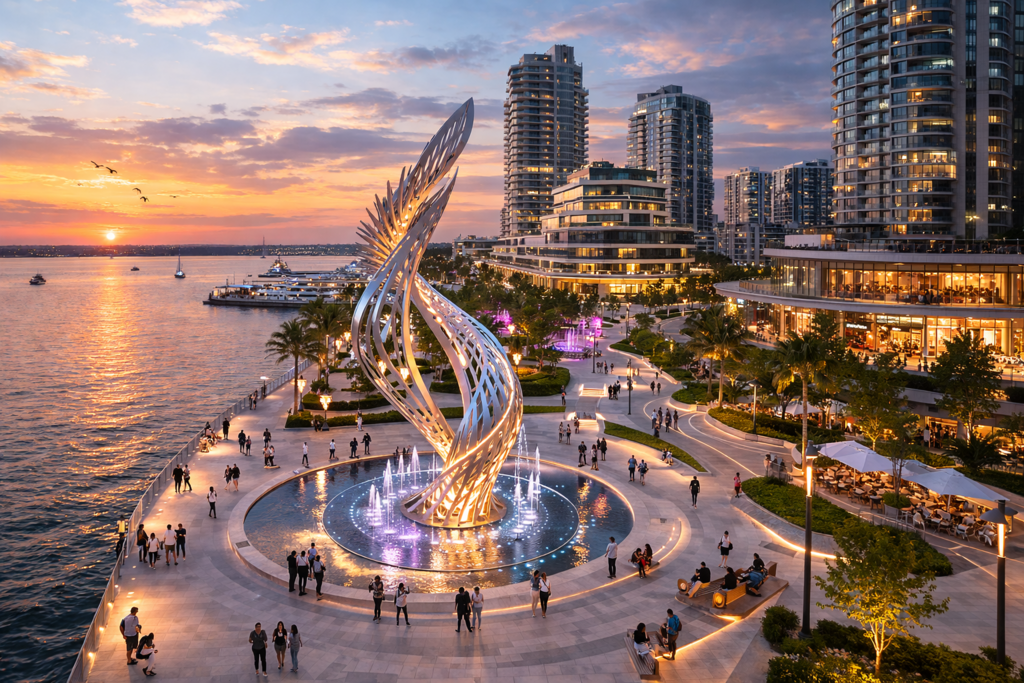
Waterfront developments illustrate this dynamic particularly well. These projects typically combine residential towers, retail zones and public promenades along extended coastal edges. While the architecture may define the urban edge, sculptural elements often become the visual anchors that give the place its recognizable image.
A kinetic sculpture positioned at the intersection of promenade pathways, for instance, can function simultaneously as a landmark, meeting point and spatial orientation device. Its movement introduces visual energy into the public realm, attracting visitors and reinforcing the identity of the waterfront.
In such contexts, sculptural installations become part of the urban masterplan rather than additions after construction. Their placement influences how people occupy the space, where they gather and how they move through the public landscape.
Landmark Objects in Masterplanning
Large masterplanned developments — from business districts to residential complexes — often require a hierarchy of landmarks to structure the spatial composition at multiple scales.
At the urban scale, towers or cultural buildings may function as primary landmarks. At the pedestrian scale, however, smaller elements are required to organize everyday spatial experience.
Sculptural installations frequently fulfill this role. Positioned at plazas, transit nodes or entrance axes, they create identifiable points within the urban fabric.
In business districts, for example, public plazas between office towers can feel anonymous without a defining element. A large kinetic sculpture placed within the plaza introduces both spatial focus and visual identity. Employees and visitors begin to associate the location with the installation, turning the space into a recognizable destination.
The same logic applies to residential masterplans. Large housing developments often incorporate central parks or shared courtyards. Sculptural landmarks within these spaces help residents orient themselves and strengthen the perceived identity of the neighborhood.
Sculptural Installations in Large Public Interiors
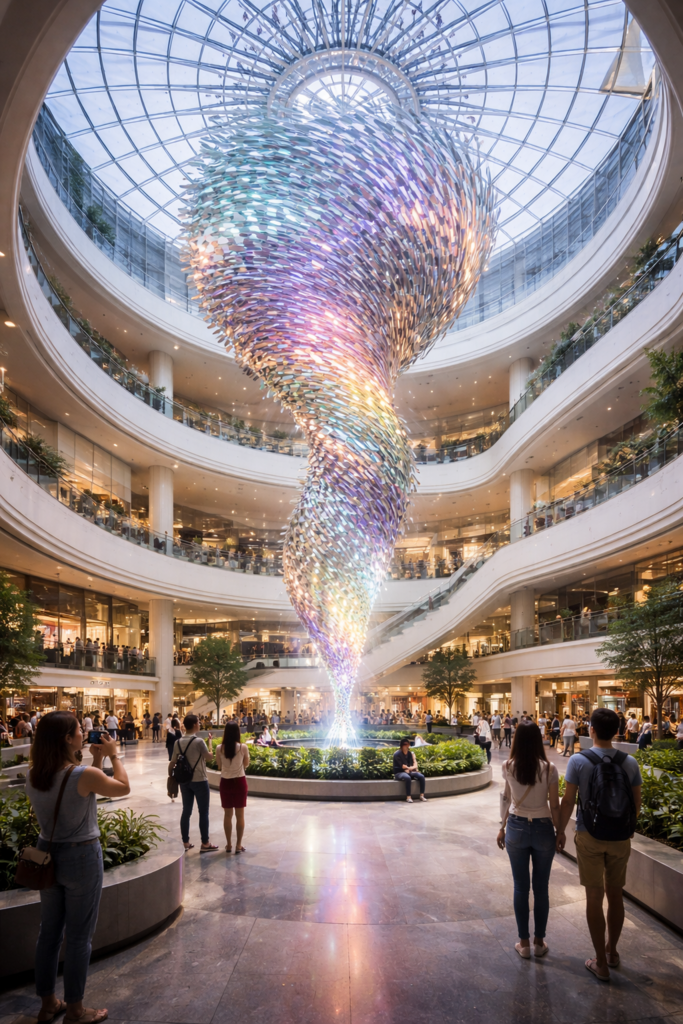
Large interior spaces — shopping malls, convention centers and transport hubs — present unique spatial challenges. Their scale often exceeds that of traditional civic architecture, resulting in interiors that can feel visually monotonous or disorienting.
Sculptural installations help break this continuity. When suspended within central voids or positioned within atrium spaces, they introduce vertical articulation into otherwise horizontal environments.
In a large shopping mall, for instance, a kinetic sculpture installed above a central circulation space can establish a visual core around which multiple levels of retail are organized. Visitors navigating between floors naturally orient themselves relative to the installation.
Light also plays a crucial role in these environments. Reflective kinetic elements interact with artificial lighting systems, producing dynamic visual effects that extend across ceilings and floors. The installation becomes part of the interior atmosphere rather than a discrete object.
These spatial strategies transform large interiors into environments with recognizable centers and identifiable zones. Visitors remember where they were, where they entered and how they navigated the space — an essential aspect of successful large-scale public architecture.
As contemporary architecture continues to operate at increasingly large scales, the need for spatial anchors becomes more critical. Sculptural installations — particularly kinetic ones — offer architects and urban designers a powerful tool for structuring perception, guiding movement and reinforcing identity within complex environments.
Their influence extends beyond visual expression. When integrated thoughtfully into architectural and urban design strategies, these installations contribute to spatial hierarchy, orientation and placemaking.
In airport terminals, they clarify circulation. In waterfront districts, they establish civic identity. In museum atriums and commercial interiors, they transform volume into experience.
Rather than existing outside architecture, kinetic sculptures increasingly operate within it — as moving architectural elements that shape how people perceive and inhabit space. For designers working on large public environments, they represent not an artistic accessory but a spatial instrument capable of redefining the character and legibility of contemporary public architecture.
More Stories
How Premium Upgrades Can Enhance the Beauty of Smart Homes
LOA Construction vs Kidd Roofing vs Ja-Mar Roofing: Which Reputable Austin Roofing Contractor Is Best Overall?
Viking vs Austex vs Purple: Local Residential Fencing Companies in Austin Reviewed (2026)