
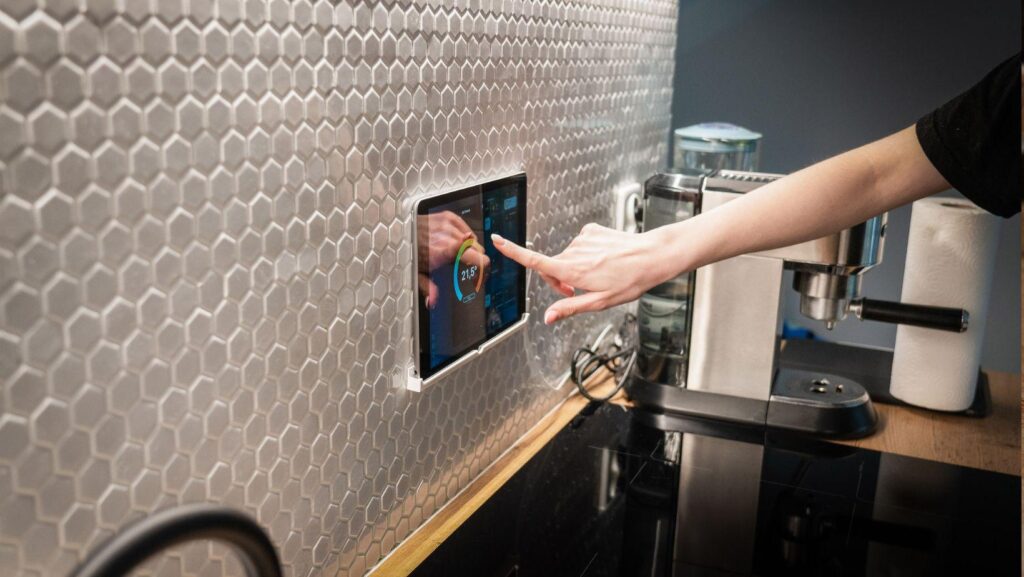
Today’s high-end homes are defined by more than their infinity pools or marble countertops. They are fitted with cutting-edge smart technology that transforms them into aesthetically impressive, safe, comfortable havens where families can unwind and connect. While automated homes aren’t a novelty, the systems that define them have changed drastically over the past few years. For instance, instead of juggling multiple disjointed applications, discerning homeowners are using centralized operating systems such as Josh.ai, Crestron, or Lutron, which unify everything from pool controls to lighting in a single interface. Just a few of the top technologies holding sway are predictive AI, responsive maintenance, biometric security, and holistic wellness design.
Predictive Automation
The ultimate in comfortable home life involves living alongside AI-based systems that learn your habits and adjust your environment to your preferences, without you having to take any action. A recent Global Market Insights report states that this technology is already being used in multiple homes to improve comfort, reduce energy use, and personalize living experiences. Predictive automation can perform a wide array of tasks, including raising your bedroom blinds at your usual wake-up time, pre-cooling or pre-heating your bedroom before you arrive, or lowering your shades automatically when the afternoon sun reaches specific spaces in your home.
Responsive Maintenance
Even the best fixtures, equipment, and systems can break down, which is why relying on AI to flag what needs fixing is vital. Imagine an AI-powered fixture (such as a smart electrical panel) that tracks microsecond-level deviations in current and voltage, or spots invisible faults such as insulation degradation. AI in smart homes helps with tasks such as identifying the exact causes of failures, transmitting error codes to your service provider, and finding a local electrician to resolve problems before they become costly. The sooner electrical, insulation, and equipment issues are addressed, the less likely costly replacements will be necessary.
Biometric and Luxury Home Security
Most smart homes have security measures such as video doorbells and motion-activated lights, but a growing number are embracing next-level biometric home security systems. These use unique human characteristics, such as fingerprints, facial features, and iris patterns, to recognize individuals and grant or deny them access to homes. Biometric technology adds the ultimate layer of security to homes, as intruders cannot gain entry by obtaining passwords or stealing phones. Some systems recognize license plates at gates, while others have AI cameras that can distinguish vehicles, people, and even animals. Of course, most systems allow homeowners to manage security at their second homes via dedicated apps.
Holistic Wellness Design
The aim of holistic wellness is to achieve optimal balance and harmony across all aspects of a person's life. It values the connection between body, mind, and spirit, encouraging people to prioritize self-care and proactive stress management. Smart home design can help dwellers achieve this goal in multiple ways. For instance, smart, multi-room audio systems can synchronize sound throughout a home, playing relaxing music for some inhabitants and more upbeat music for others. Hobbies and physical activity are also central to holistic living, and some luxury smart homes incorporate immersive golf, dance, or aviation simulators. Beyond providing entertainment, these technologies encourage regular movement, sharpen coordination and improve reaction times, and offer an engaging way to unwind without leaving home. Other features of wellness-centered design include circadian lighting systems (which automatically adjust color temperature and brightness throughout the day to support high-quality sleep), whole-home air purification via HEPA filtration, and automated scent diffusion, in which aromatherapy oils are released during relaxation routines. Technology is also used to enhance a home's biophilic features, such as automated skylights, smart irrigation for indoor living walls, or lighting that mimics natural daylight.
Premium upgrades are elevating beauty and comfort in smart homes to a whole new level. High-end homes are currently embracing technologies such as predictive AI, responsive maintenance, biometric security, and holistic wellness design to make homes safer and more comfortable. Automation, meanwhile, can learn human beings’ chosen lifestyle patterns and create a bespoke home life experience that reflects real needs. These technologies are also being used to give home dwellers a deeper sense of health and wellness. Music, lighting, and temperature all influence everything from mood and stress levels to sleep quality.
More Stories
Responsive Design Isn’t Enough: Why Purpose-Built Mobile Landing Pages Convert 2x Better
Move Out Cleaning Tips That Protect Your Deposit
Ductless HVAC Systems: The 2026 Guide To Smarter, More Efficient Home Comfort